
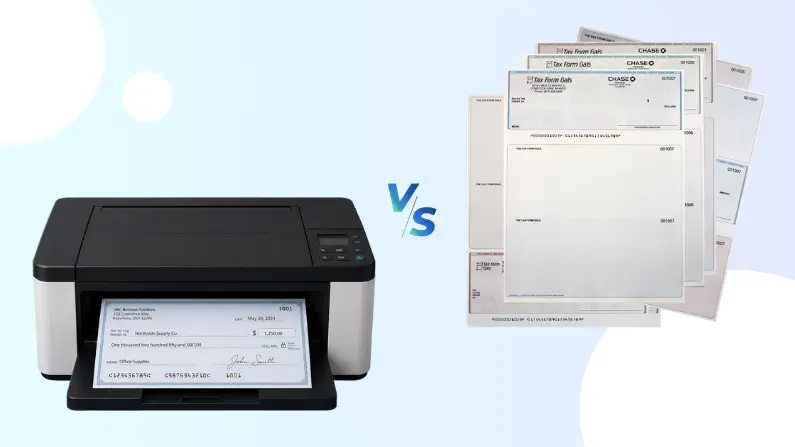
Businesses that still pay vendors, contractors, employees, customers, or other recipients by check generally have two choices: order pre-printed checks in advance or use check-printing technology to create checks as payments are needed.
The difference may appear simple, but the financial impact goes well beyond the price of check stock.
FiChecks recently addressed this question in an EIN Presswire release examining the cost of traditional pre-printed checks compared with an on-demand check printing model. The analysis highlights an important issue for finance teams: check cost should be measured by the total cost of issuing a payment, not only by what a business pays to purchase the check itself.
For businesses managing regular check payments, understanding printing costs, labor, inventory, postage, reprints, and administrative overhead can help determine which model offers the better long-term value.
What Is the Real Cost of Check Printing?
The price of a business check is only one part of its total cost.
A traditional check payment workflow may involve expenses such as:
- Pre-printed check stock
- Check ordering and reordering
- Shipping charges for check supplies
- Secure check storage
- Employee processing time
- Printer and printing expenses
- Envelopes and mailing supplies
- Postage or delivery
- Reprints caused by errors
- Check inventory management
- Payment reconciliation
- Recordkeeping and administrative work
For this reason, the cost per check can be significantly higher than the check’s face value.
This distinction becomes especially important when comparing pre-printed checks with on-demand business check printing.
A box of checks may appear inexpensive when purchased in bulk. However, a business also has to consider how much time and money are spent storing, managing, issuing, mailing, tracking, and replacing those checks.
What Are Pre-Printed Checks?
Pre-printed checks are checks ordered in advance with certain business and banking information already printed on the check stock.
Many accounting departments are familiar with this model because preprinted business checks have been used for decades. Businesses can order checks for a specific bank account and maintain a supply for future payments.
The model works, but it creates an inventory-based payment process.
Every set of checks is associated with particular information, which means businesses may need separate check stock for different bank accounts, companies, locations, or payment workflows.
Common Costs Associated With Pre-Printed Checks
The cost of pre-printed checks can include more than the original order.
Businesses may need to account for:
- Minimum order quantities
- Bulk check purchases
- Shipping and handling
- Storage of unused check stock
- Reordering when inventory becomes low
- Separate stock for multiple bank accounts
- Replacement when banking information changes
- Unused checks after an account is closed
- Manual check handling
- Additional controls around sensitive check inventory
Bulk purchasing may reduce the price of each individual check, but it can also create an inventory commitment.
That may be manageable for organizations with predictable payment volumes. For smaller companies or businesses managing multiple accounts, however, unused stock and administrative work can reduce those savings.
What Is On-Demand Check Printing?
On-demand check printing changes the process by allowing businesses to create checks when they actually need to issue a payment.
Instead of ordering large quantities of checks containing account-specific information, businesses can use blank check stock and generate the necessary payment information during the check creation process.
With FiChecks, businesses can create and print checks on demand while also managing check mailing, emailed checks, payment records, and ACH payments from a centralized platform.
This approach shifts check issuance away from an inventory-heavy process toward a more flexible payment workflow.
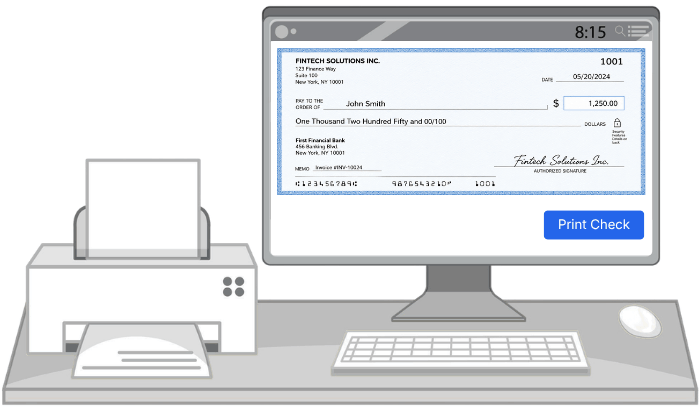
Blank Check Stock vs. Pre-Printed Check Stock
The difference between blank check stock and pre-printed check stock is important when evaluating overall check printing costs.
Pre-printed checks are prepared in advance for a particular account or business configuration.
Blank check stock provides greater flexibility because the required information can be generated when the payment is created.
For a business managing several bank accounts, entities, or payment types, this can significantly simplify check inventory.
Instead of maintaining different sets of checks for different accounts, an on-demand workflow can allow the business to select the appropriate payment information when creating the check.
That can help reduce:
- Excess check inventory
- Account-specific stock requirements
- Reordering frequency
- Wasted checks
- Storage requirements
- Administrative complexity
How to Calculate Your Annual Check Printing Cost
Businesses can perform a basic cost-benefit analysis using this formula:
Annual Check Cost = Number of Checks Issued × Total Cost Per Check
For example, a company issuing 500 checks every month processes:
500 × 12 = 6,000 checks annually
If its actual processing cost is $3 per check:
6,000 × $3 = $18,000 per year
When evaluating check printing software or an on-demand check service, businesses can compare that figure with the cost of the alternative model.
For a more accurate calculation, include:
- Check paper or stock
- Check printing
- Labor
- Envelopes
- Postage
- Mailing
- Software costs
- Reprints
- Storage
- Inventory management
- Reconciliation time
- Administrative overhead
This gives finance teams a much more realistic understanding of business check printing costs.
Hidden Costs of Pre-Printed Business Checks
Some check-related expenses are obvious. Others remain hidden inside everyday accounting operations.
1. Unused Check Inventory
Bank accounts change. Business entities change. Payment volumes fluctuate.
Pre-printed checks that are no longer usable become wasted inventory.
2. Reordering Costs
Traditional business checks have to be monitored and reordered before supplies run out.
For businesses with several bank accounts, this process may need to be repeated across multiple sets of checks.
3. Employee Labor
Someone has to prepare, verify, print, sign, organize, mail, and reconcile check payments.
Even a few minutes per transaction can become a significant operational expense at higher check volumes.
4. Check Reprints
Incorrect payee details, amounts, addresses, or other payment information may require a check to be voided and reissued.
That increases both material and labor costs.
5. Multiple Bank Accounts
Organizations operating several businesses or bank accounts may need separate pre-printed check supplies.
An on-demand check printing platform can simplify this by allowing payment information to be selected during check creation.
6. Storage and Control
Pre-printed checks contain sensitive financial information and generally require controlled storage and access.
Reducing the amount of pre-printed inventory can simplify physical check management.
Why Businesses Are Moving Toward Print-on-Demand Checks
The value of print-on-demand checks is not limited to lower check stock costs.
The larger advantage is workflow flexibility.
A business can create a check when it needs one instead of predicting future demand and ordering inventory in advance.
For growing businesses, bookkeepers, accounting teams, and organizations handling payments from multiple bank accounts, that flexibility can make check management easier to scale.
On-demand check creation can also fit into broader accounts payable processes that include:
- Vendor payments
- Contractor payments
- Customer refunds
- Employee reimbursements
- Recurring payments
- Multiple business accounts
- Payment tracking
- Check mailing
- Digital check delivery
- ACH payments
This allows businesses to think about check printing as part of a larger payment management workflow, rather than as a standalone printing task.
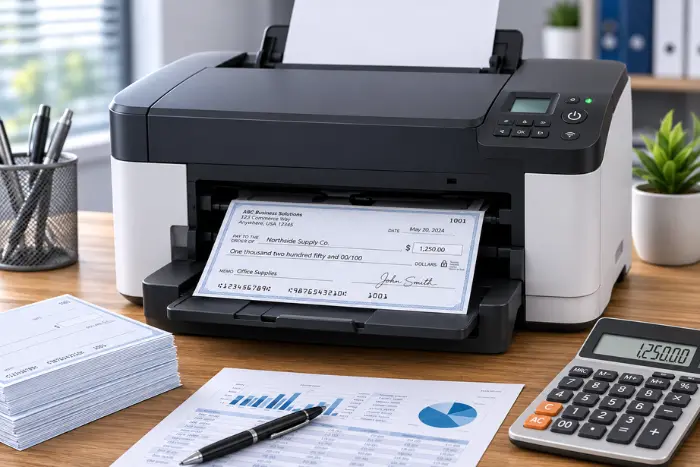
Business Check Printing Without Managing Large Check Inventories
FiChecks provides businesses with tools to create and print checks online as payments are needed.
Businesses can enter the payment information, select the appropriate account, generate the check, and print it using their check printing workflow.
For businesses that do not want to handle physical fulfillment themselves, FiChecks also supports check mailing. When faster electronic delivery is preferred, checks can be sent digitally, while ACH provides another option for eligible electronic payments.
Bringing these payment methods together helps businesses manage different recipient preferences without maintaining completely separate payment systems.
FiChecks’ Approach to Lower-Cost Check Issuance
FiChecks is designed to bring check creation, check printing, check mailing, digital check delivery, and electronic payments into one payment workflow.
Rather than requiring businesses to rely exclusively on large inventories of pre-printed checks, payments can be created when they are required.
That can help finance teams reduce inventory dependence while maintaining the option to issue physical checks when recipients still need them.
As FiChecks Founder and CEO Dr. Saheer Nelliparamban explained in the company’s release, FiChecks identified the advantages of printing on blank check stock early in the development of its solution and built the platform around providing additional flexibility to customers.
For businesses evaluating their payment operations, the bigger opportunity is not simply cheaper check paper. It is reducing the total cost and administrative burden of issuing checks.
Frequently Asked Questions
What is the best way for businesses to manage check payments online?
Businesses can simplify check payments by using a digital platform to create, send, print, and track checks from one place. FiChecks helps businesses manage check payments online without relying on a fully manual process.
How can businesses send checks without mailing them manually?
Businesses can use digital check platforms to email checks directly to recipients, allowing them to receive and process payments faster. FiChecks enables businesses to create and email checks online while maintaining payment records in one platform.
Can businesses print and mail checks online?
Yes, businesses can use online check services to create checks digitally and arrange printing or mailing without preparing each check manually. FiChecks supports check printing and mailing workflows for businesses that still need physical check payments.
What is the easiest way to manage business check payments?
The easiest approach is to use one system for creating checks, managing payees, tracking transactions, and choosing how each check is delivered. FiChecks brings these functions together so businesses can manage check payments from a single platform.
Check Printing vs. Pre-Printed Checks
| Cost Factor | FiChecks On-Demand Model | Traditional Pre-Printed Checks |
|---|---|---|
| Estimated cost used in analysis | $0.29 per check | $2–$5 per issued check |
| Pre-order check inventory | Reduced or eliminated | Typically required |
| Account-specific stock | Reduced | Often required |
| Reordering | Lower dependency | Recurring requirement |
| Unused stock risk | Lower | Higher |
| On-demand printing | Yes | More limited |
| Digital payment records | Integrated | Depends on workflow |
| Multiple payment options | Checks, email, mail, ACH | Primarily check based |
| Inventory management | Lower | Higher |