

Electronic Funds Transfer is now a common way people and businesses move money. Companies rely on it to pay staff and vendors, and people use it to pay bills, send money, and manage everyday spending. Funds move directly between accounts, which makes payments quick, easy, and transparent.
As businesses grow and operate across different locations, Electronic Funds Transfer keeps payments simple and reduces manual work. It supports modern workflows where speed, accuracy, and clear visibility into transactions are important.
What Electronic Funds Transfer Really Means
Electronic Funds Transfer, often called EFT, refers to any digital method that moves money from one account to another without using physical cash or paper checks. The transfer happens through secure banking or payment networks.
Simply put, instead of writing a check or using cash, you send the payment online and the money moves electronically. This could be between two bank accounts, through an automated system, or via an online payment platform.
Electronic Funds Transfer is used in both personal and business finance because it reduces delays and manual handling.
How Electronic Funds Transfer Works in Simple Terms
The process of Electronic Funds Transfer is straightforward. A sender starts the payment through a bank or payment platform. The platform checks the account information and routes the payment securely. After the funds arrive, the sender and recipient both receive a transaction record.
Most transfers follow a few basic steps.
- The sender enters the payment details.
- The system checks the account and approval.
- The money moves through a bank or payment network.
- The recipient gets the funds, and the system stores the transaction record.
Depending on the payment method, this process can happen in seconds or within one business day.
Common Types of Electronic Funds Transfer
Electronic Funds Transfer covers multiple payment options that people and companies use in daily transactions.
- Bank to bank transfers allow money to move directly between financial institutions.
- Automated payments handle recurring transactions like subscriptions or utilities.
- Payroll transfers let companies pay staff automatically without checks or cash.
- Online payment systems support digital platforms for sending and receiving funds.
Every type has its own use case, but they all belong to the Electronic Funds Transfer category.
Benefits of Using Electronic Funds Transfer
Electronic Funds Transfer offers clear advantages for both businesses and individuals.
- Faster payments reduce waiting times compared to paper checks.
- Less paperwork lowers administrative work and storage needs.
- Security features protect against fraud and unauthorized access.
- Cost efficiency reduces printing, mailing, and handling expenses.
- Automated payments make scheduling regular transfers easier and more accurate.
- Better record keeping makes it easier to track transactions and reconcile accounts.
Because of these benefits, Electronic Funds Transfer works well for modern businesses and everyday payments.
Everyday Use Cases for Electronic Funds Transfer
Electronic Funds Transfer is widely used across many business and personal scenarios.
- Payroll is one of the most common uses, where employees receive salaries directly in their accounts.
- Vendor payments help businesses pay suppliers and service providers quickly and on time.
- Recurring bills like rent, utilities, and subscriptions can be set up to run automatically.
- Contractor payouts make it easy to pay freelancers and remote workers across different regions.
- Refunds are processed faster when sent electronically.
- International transfers help companies pay global partners and teams.
This shows how Electronic Funds Transfer helps with routine payments as well as more complex money movement.
Managing Electronic Funds Transfer Alongside Other Payment Methods
Even though Electronic Funds Transfer is widely used, businesses often mix different payment methods. Checks are still required in some cases, digital wallets are popular with customers, and wire transfers are chosen when speed or large amounts matter.
A flexible payment system lets businesses pick the best payment method for each situation instead of using just one option.
How FiChecks Supports Flexible Money Movement
FiChecks is built to support multiple ways to send money, including Electronic Funds Transfer options and traditional payment methods.
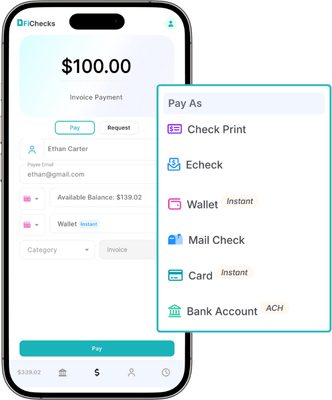
FiChecks lets users create and send checks online, print them, email them as eChecks, or mail them through USPS or FedEx. Businesses can also send ACH transfers, wire payments, and digital wallet payments, all in a single workflow.
Electronic Funds Transfer fits easily into this setup. Teams can use automated transfers for quick payments and rely on checks or other methods when compliance or vendor requirements matter.
Combining Electronic Funds Transfer With Digital Workflows
Modern finance teams often use Electronic Funds Transfer along with other digital tools to work more efficiently. Payment records connect with accounting systems, dashboards show transaction history, and automated scheduling reduces manual work.
This combination helps businesses stay in control while spending less time managing payments. It helps make audits and internal reviews clearer and simpler to follow.
Why Electronic Funds Transfer Matters for Growing Businesses
When companies scale, manual payment processes quickly become hard to manage. Electronic Funds Transfer makes it easier to scale by reducing manual work and supporting automation. It also helps companies work across regions and currencies with fewer barriers.
For startups and enterprises alike, Electronic Funds Transfer helps create a dependable payment system that supports future expansion.
Conclusion: Moving Toward Modern Payment Workflows
Electronic Funds Transfer has transformed how money moves today. It speeds up payments, reduces paperwork, improves security, and keeps records organized. From payroll and vendor payouts to international transfers, it is now a key part of everyday financial operations.
Platforms like FiChecks help businesses combine Electronic Funds Transfer with other payment options such as online checks, eChecks, mailed checks, ACH, wire transfers, and digital wallet payments. This flexibility allows teams to choose the right method for every transaction.
Using Electronic Funds Transfer and modern payment tools helps businesses and individuals handle money more easily, reduce costs, and stay in control of their finances.