
Payment Rails
Payment Rails to move money through different payment channels, networks, and financial systems. FiChecks gives businesses a flexible way to manage bank transfers, ACH payments, checks, digital payments, and other transaction methods while keeping payment activity organized and accessible.
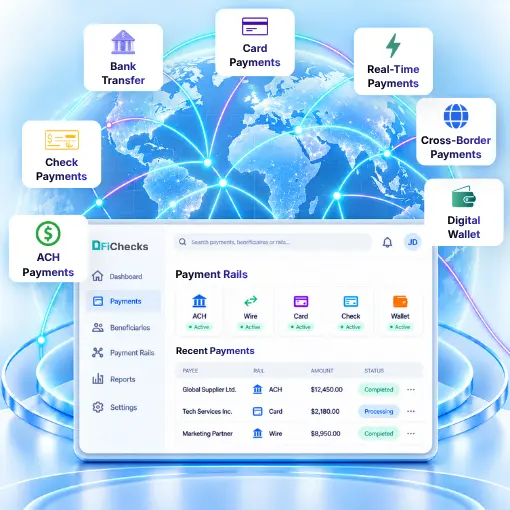
Payment Channels
Global Payment Rails
Real-Time Payment Rails
Secure Payment Infrastructure
WHY PAYMENT MOVEMENT GETS COMPLEX
Moving Money Across Different Networks Takes Coordination
Businesses rarely rely on a single way to send or receive money. Customer payments, vendor transfers, refunds, payroll, reimbursements, and other transactions may move through different banks and payment networks.
Without the right infrastructure, managing these transactions can mean working across disconnected systems and manually tracking payment activity.
No. 1
Multiple payment channels
Businesses may need to support ACH, checks, bank transfers, and digital payment methods depending on the transaction and recipient.
No. 2
Different processing requirements
Each payment method can have its own processing rules, delivery times, and tracking requirements, making payment operations harder to manage.
No. 3
Cross-border transactions
Companies operating across markets may need access to different networks and payment methods to move funds between countries.
No. 4
Limited payment visibility
When transactions move through separate platforms, teams can struggle to see payment status, transaction history, and delivery information in one place.
HOW PAYMENT RAILS WORK
Connect Payment Methods Through One Payment Infrastructure
Businesses can use payment rails to route transactions through the appropriate payment channel based on the payment type, recipient, and operational requirements.

Select
Choose the payment method and enter the required transaction details.

Review
Verify recipient information, payment details, and processing requirements before sending.

Route
Direct the transaction through the appropriate payment network or channel.

Track
Monitor transaction status, delivery activity, and payment history from one location.

Manage
Review records, reconcile transactions, and access payment information whenever needed.
PAYMENT TOOLS FOR EVERYDAY TRANSACTIONS
One Platform for Different Payment Methods
Businesses need flexibility when choosing how money moves. FiChecks brings multiple payment methods together so teams can manage different transaction types without relying on disconnected workflows.
ACH Payments
Send electronic bank transfers for vendor payments, refunds, reimbursements, and other business transactions.
Digital Check Payments
Send checks electronically without printing or mailing physical documents.
Check Printing
Create and print professional business checks using an existing printer and compatible check stock.
Check Mailing Services
Have FiChecks print, package, and mail checks while keeping delivery activity accessible.
Bank Transfers
Move funds electronically between bank accounts for business and operational transactions.
Recurring Payments
Schedule recurring transactions for regular business expenses and ongoing payment obligations.
BUILT FOR MODERN PAYMENT OPERATIONS
Support Different Ways to Send and Receive Money
Payment rails can support a wide range of business use cases, from everyday transfers to recurring transactions and larger payment operations.
Accept customer payments through supported channels
Pay vendors and service providers
Send refunds and reimbursements
Process recurring business payments
Distribute funds to employees, partners, or contractors
Manage domestic and cross-border transactions
Track payment activity across different channels
Connect Payment Channels Around Your Existing Workflow
Businesses already use accounting platforms, banking systems, ERP software, CRM tools, and other applications to manage daily operations.
FiChecks focuses on payment movement, giving teams access to multiple payment methods while keeping transaction information organized.
Supports multiple payment channels
Centralized payment tracking and reporting
Flexible options for sending and receiving funds
Frequently Asked Questions
What are payment rails and how do they work?
Payment rails are the networks and infrastructure used to move money between a sender and recipient. They can support methods such as ACH, bank transfers, card transactions, and other electronic payment channels. FiChecks gives businesses access to multiple payment methods through one platform.
What types of payment rails can businesses use?
Businesses can use different payment networks and channels depending on the transaction, location, recipient, and payment method. FiChecks supports payment options including ACH, bank transfers, digital checks, printed checks, and mailed checks.
How can businesses manage multiple payment channels from one platform?
Businesses can manage different transaction types through a centralized payment workflow instead of handling every payment method separately. FiChecks provides tools for creating, sending, tracking, and reviewing payments across supported channels.
Payment Rails vs Traditional Payment Workflows
Traditional payment workflows often require businesses to use separate systems for bank transfers, checks, payment tracking, reconciliation, and reporting. A multi-rail approach brings different payment channels into a more connected workflow, allowing businesses to select the appropriate method for each transaction while maintaining better visibility. FiChecks supports this approach by bringing multiple payment methods and transaction management tools together in one platform.