
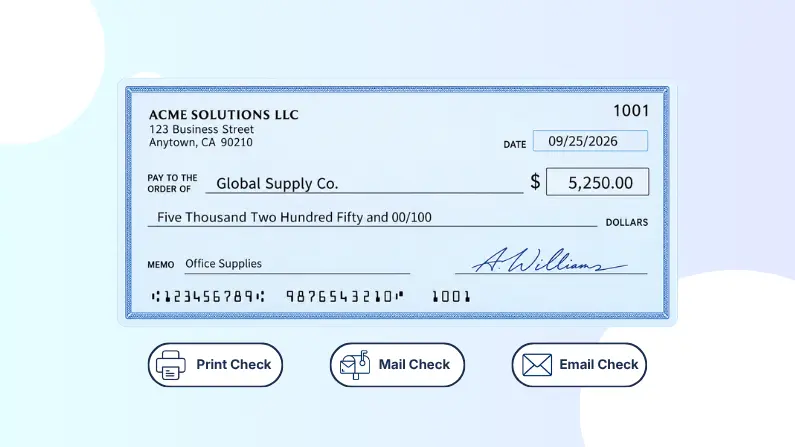
Online check payments are becoming more relevant to businesses as companies look for faster, more controlled ways to manage payments without completely moving away from checks. While ACH, cards, and other electronic payment methods continue to grow, checks remain part of many business-to-business payment workflows.
Research from the Federal Reserve Bank of Cleveland shows that nearly 90% of U.S. businesses still use checks for at least some B2B payments. The opportunity is not necessarily to eliminate checks, but to modernize how businesses create, approve, deliver, track, and reconcile them.
Business Check Use Is Declining, Not Disappearing
B2B check usage has declined significantly over the past decade. According to Federal Reserve Bank of Cleveland research, the number of B2B check payments fell from 4.6 billion in 2015 to 2.7 billion in 2024. During the same period, ACH payments increased from 3.6 billion to 8.7 billion.
Despite this decline, checks remain widely used. Industry survey data cited by the Federal Reserve indicates that 87% of businesses still used checks in 2025. The value of B2B check payments also remained significant at approximately $15 trillion in 2024, with an average transaction value of about $5,577.
These figures show that checks are declining as a payment method, but they have not disappeared from business finance. Many companies continue to use them for vendor payments and other important transactions.
Why Businesses Still Use Checks
Checks remain part of business payment processes for several practical reasons. Some vendors prefer receiving checks, while many accounts payable departments already have established procedures for issuing, approving, and reconciling them.
Replacing checks with another payment method can also require changes to vendor onboarding, accounting procedures, internal approvals, and reconciliation processes. For many businesses, modernization does not have to mean eliminating checks.
Instead, companies can move more of the process online. Check creation, approvals, recordkeeping, delivery, and payment tracking can all be managed through digital workflows while businesses continue using checks where they make sense.
The Real Opportunity Is Modernizing the Workflow
Traditional check processes can involve entering payment information multiple times, printing individual checks, matching payments with invoices or bills, preparing mail, updating accounting records, and confirming whether payments were sent.
Each manual step adds more work and creates opportunities for delays, duplicate tasks, or human error.
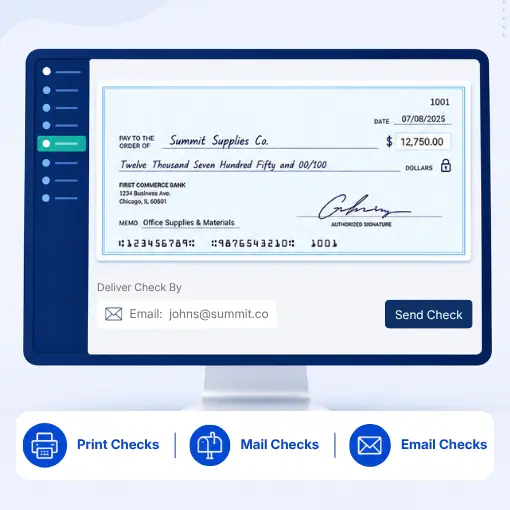
Online check payment platforms can reduce this manual work by bringing more of the process into a digital workflow. Businesses may be able to create checks online, manage payees, process multiple payments, maintain transaction histories, select delivery methods, and connect payment activity with accounting processes.
With FiChecks, businesses can create checks online, print them on plain paper or blank check stock, send eChecks, or have checks mailed to recipients. This gives businesses more control over how they manage check-based payments while reducing the need for repetitive manual work.
Fraud Risk Makes Better Controls More Important
Check fraud remains an important concern for businesses. Federal Reserve Financial Services reported in 2026 that 63% of surveyed financial institutions experienced check-fraud attempts during the previous 12 months. Respondents also reported increases in counterfeit checks, check washing, and payee forgery.
Digital workflows cannot eliminate fraud, but businesses can strengthen the controls around their payment processes. Useful measures include restricted user permissions, approval workflows, payment history, reconciliation, Positive Pay where available, and verification of changes to vendor payment information.
The goal is to make payment processes easier to monitor and control while maintaining clear records of financial activity.
Online Checks vs ACH
ACH has become the leading B2B payment method by transaction count, but that does not make checks irrelevant. ACH works well when vendors are set up for electronic bank transfers and the necessary banking information is available.
Checks can remain useful when vendors request them or when established accounts payable processes are structured around check payments.
Businesses can use both payment methods based on vendor requirements, transaction timing, costs, available information, and internal controls. The choice does not have to be between checks and ACH for every transaction.
| Attribute | Online Check Payments | ACH Payments |
|---|---|---|
| Payment method | Check-based payment managed through an online workflow | Electronic bank-to-bank transfer through the ACH network |
| Best fit | Vendors or workflows that require or prefer checks | Vendors set up to receive electronic bank transfers |
| Delivery | May be printed, mailed, or otherwise delivered as a check | Funds are transmitted electronically |
| Timing | Depends on check creation, delivery, deposit, and clearing | Depends on ACH type, submission timing, provider, and bank processing |
| Key controls | Approvals, delivery controls, reconciliation, Positive Pay where available, audit history | Approvals, account validation, authorization, fraud monitoring, reconciliation, audit history |
| Costs | Vary by platform, delivery method, printing, postage, and banking arrangements | Vary by provider, bank, transaction type, speed, and volume |
Exact availability, timing, fees, and controls vary by bank and payment provider.
What to Look for in an Online Check Payment Platform
When evaluating an online check payment platform, businesses should look beyond basic check creation. Important capabilities can include payee management, approval workflows, bulk payments, delivery options, payment records, accounting integrations, user permissions, audit history, and security controls.
Businesses should also consider how the platform fits into their existing accounts payable process. A solution should reduce unnecessary manual work without forcing vendors or internal teams to completely change established payment procedures.
FiChecks supports online check creation, printing, eChecks, check mailing, ACH, wire transfers, bank transfers, and other payment workflows through its web and mobile applications. Businesses can choose the payment method that fits their specific transaction and recipient requirements.
The Future of Online Check Payments
Check volumes may continue to decline as ACH, cards, instant payments, and other electronic payment methods expand. However, many businesses still rely on check-based workflows, making online check payments relevant to the broader shift toward digital business finance.
The future is not necessarily about choosing between traditional checks and digital payments. Instead, businesses can modernize the way they manage existing payment methods while gradually adopting electronic alternatives where they fit.
For companies that continue to pay vendors by check, online payment tools provide a way to create, print, deliver, track, and manage payments with less manual effort and better visibility.
Frequently Asked Questions
What are online check payments?
Online check payments use digital tools to create, manage, approve, deliver, or track business check payments. Depending on the provider, the final payment may still be a physical or printable check.
Are online check payments the same as eChecks?
Not necessarily. An eCheck commonly refers to an electronic bank-account payment processed through the ACH network. An online check platform may instead digitize the workflow around a traditional check. Businesses should confirm how the provider actually processes and moves funds.
Why do businesses still use checks in 2026?
Checks remain part of many vendor and accounts payable workflows. Federal Reserve Bank of Cleveland research indicates that nearly 90% of businesses still used checks for at least some B2B payments in 2025.
Can a business use both online checks and ACH payments?
Yes. Businesses can use multiple payment methods depending on vendor preferences, available banking information, transaction timing, costs, and internal controls.
How can businesses reduce check-payment fraud risk?
Common controls include restricted user permissions, multi-step approvals, reconciliation, Positive Pay where available, verification of vendor payment changes, and clear audit records. No single control eliminates fraud risk.
What should businesses look for in an online check payment platform?
Businesses should evaluate payee management, approvals, bulk payment capabilities, delivery options, accounting integrations, transaction history, user permissions, auditability, security controls, support, and pricing based on their accounts payable workflow.